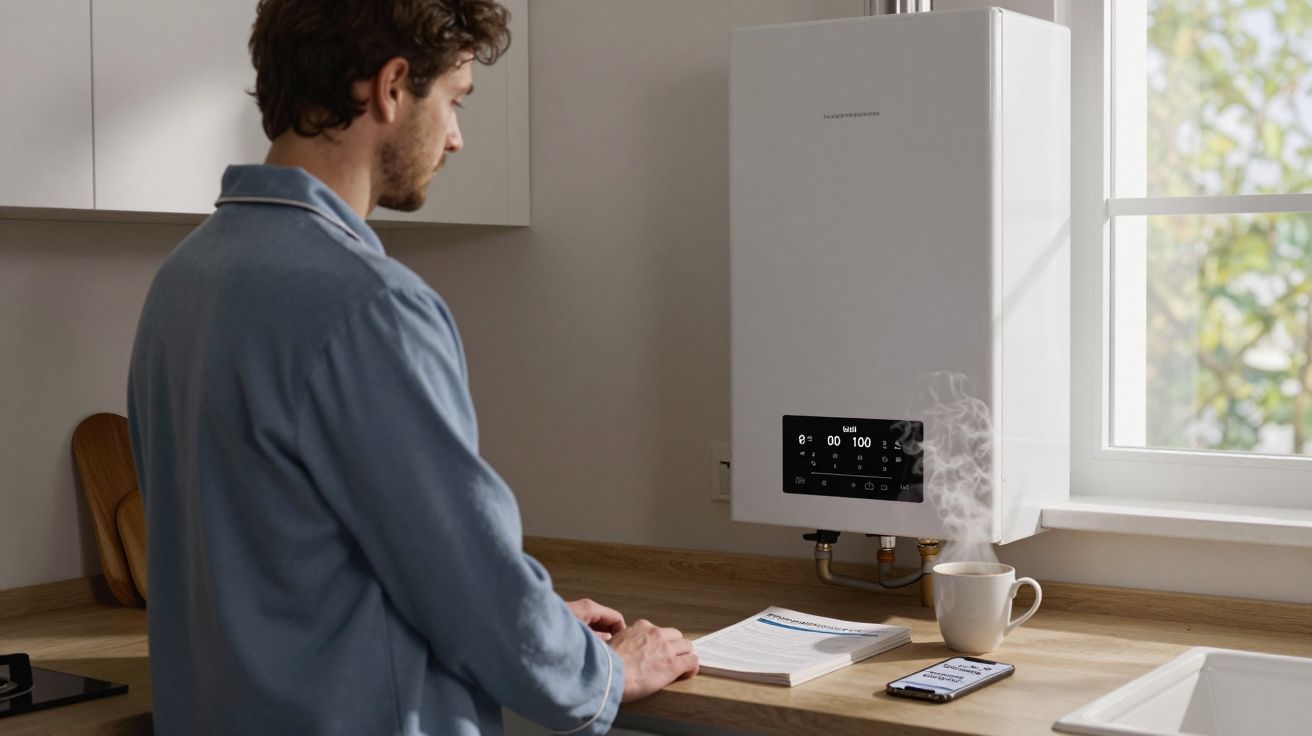
The first cold morning creeps up quietly. You wake before the alarm, see your breath hanging faintly in the bedroom, and tap the thermostat up with a sleepy thumb. The boiler clicks, whirs… and then falls silent. No radiators warming, no hot shower, just a blinking light and an error code you don’t understand.
An hour later you’re on hold to an overstretched heating company along with half your postcode. The engineer who eventually arrives wipes his boots, glances at the front of your boiler and sighs. “If this pressure had been checked last week,” he says, “you wouldn’t have needed me today.” On the display, a tiny gauge hovers near zero. The whole drama hinged on a 60‑second check.
The quiet warning on your boiler’s front panel
On almost every modern sealed system or combi boiler, there’s a pressure gauge on the front panel or just underneath. It might be a small analogue dial with coloured zones, or a digital readout in bar. Most homeowners glance past it for years, assuming it’s “just for the engineer”.
For most systems, the sweet spot when the heating is cold is around 1.0–1.5 bar (your manual gives the exact range). Below that, the system may struggle to circulate water properly. Above about 2.5–3.0 bar, the safety valve can lift and dump water outside. Neither extreme is friendly to your boiler when the first real cold snap hits.
Pressure is simply the push that sends hot water around your radiators. Tiny leaks, natural air build-up and seasonal expansion all nudge it down over time. Left unchecked, it keeps dropping until the boiler locks out to protect itself, usually on the very morning you finally need the heating.
Why cold snaps expose weak boilers
Through autumn, your system drifts along gently. The boiler only fires now and then, metal pipes expand and contract modestly, and any slow loss of pressure goes largely unnoticed. Then the temperature plunges overnight and the whole system is suddenly asked to work flat out.
Radiators run hotter for longer, pipework flexes more, and any weak seal, pinhole or tired expansion vessel is pushed to its limits. If your pressure was already marginal, that extra strain tips it over the edge. The boiler sees an unsafe reading and shuts itself down just when the house feels like a fridge.
Frozen condensate pipes and power cuts may grab the headlines, but heating engineers quietly see the same pattern every year: a wave of no‑heat call‑outs caused by low system pressure that could have been spotted days earlier. One small habit in late autumn changes that story entirely.
The 60‑second check engineers wish you’d do
Think of this as the boiler’s version of checking your tyre pressure before a long drive. It’s quick, clean, and for most people it’s well within reach.
Make sure the system is cool.
Ideally, do this after the heating has been off for at least an hour so you’re reading the “cold” pressure.Find the gauge.
- On many combis it’s on the front panel, sometimes as a round dial.
- On some system boilers it’s under a flap or on nearby pipework.
If you can’t see it, your manual or manufacturer’s website will show you.
- On many combis it’s on the front panel, sometimes as a round dial.
Read the number.
- Look for a figure in bar (often between 0 and 4).
- Note whether the needle sits in a green or white “normal” zone, or strays into a red area.
- Look for a figure in bar (often between 0 and 4).
Compare with the guide range.
As a broad rule of thumb:- Around 1.0–1.5 bar cold: usually fine.
- Below 0.8 bar cold: time to act.
- Below 0.5 bar: many boilers will refuse to run.
- Above 2.5 bar cold: get professional advice; do not keep topping up.
- Around 1.0–1.5 bar cold: usually fine.
Let’s be honest: hardly anyone checks this regularly unless something has already gone wrong. But once you’ve found the gauge and looked at it a couple of times, it becomes as natural as glancing at the fuel level in your car.
Topping up safely – and when to stop
If your pressure is just a little low and the system is otherwise healthy, topping up is usually straightforward. Most sealed systems have a filling loop - often a small braided hose with one or two valves beneath the boiler.
The general sequence (always defer to your boiler’s instructions) is:
- Turn the boiler off and let it cool.
- Identify the correct filling valves (your manual shows their location and direction).
- Slowly open the valve(s) while watching the pressure gauge.
- Close the valves as the needle reaches the recommended cold pressure (often around 1.2–1.5 bar).
- Switch the boiler back on and check for normal operation.
A few important boundaries matter here:
- Never guess the valves. If you’re not certain which ones form the filling loop, stop and ask a professional.
- Don’t overfill. If you shoot past 2 bar while the system is cold, you may create a different problem when it heats up.
- Don’t keep topping up a “leaky” system.
If pressure drops back down within days or weeks, there’s an underlying fault that needs a Gas Safe engineer.
Engineers often say a top‑up once or twice a year is fairly normal. Doing it every few days is not. Repeatedly forcing more water in dilutes corrosion inhibitors and can accelerate wear. The filling loop is a tool, not a lifestyle.
Reading the signs: when your boiler is talking to you
Your boiler and pipework offer subtle clues that pressure isn’t quite right, long before a full shutdown.
- Radiators warming unevenly or needing frequent bleeding.
- Gurgling or rushing water sounds at startup.
- The pressure gauge dropping noticeably every week.
- Occasional error codes that clear with a reset, then return.
- Damp patches around valves, radiator tails or the boiler itself.
Each of these hints is a small nudge to look at the gauge rather than wait for the first icy morning meltdown. The habit is simple: any odd heating behaviour? Glance at the pressure first.
Here’s a quick translation sheet:
| Pressure state | What you’ll likely see | Sensible next step |
|---|---|---|
| 1.0–1.5 bar cold | System heats normally | Note it; re‑check monthly in winter |
| 0.5–0.9 bar cold | Radiators may be patchy; boiler sometimes grumbles | Top up carefully once; monitor closely |
| Repeated drop or >2.5 bar cold | Error codes, water from outside pipe, or no obvious change | Call a Gas Safe engineer; don’t keep refilling |
Small pre‑winter habits with big pay‑offs
Checking pressure is one part of a simple, low‑effort autumn routine that heating engineers quietly wish more households adopted.
Do a full radiator round.
Bleed cool radiators, then re‑check pressure and top up only at the end. Bleeding releases air, which lowers pressure.Listen on first start‑up.
Turn the heating on for an hour on a mild day. Unusual bangs, kettling or constant gurgling are early warning signs, not winter background noise.Know where the pipes go.
Find the pressure relief discharge pipe (often a small copper pipe exiting outside) and the white plastic condensate pipe. Drips or stains on the copper pipe, or frequent frozen condensate in past winters, are both reasons to talk to an engineer before it turns truly cold.Get ahead on servicing.
An annual service before peak season means the engineer can spot expansion vessel issues, tiny leaks and failing valves long before the first freeze exposes them.
None of this is dramatic. That’s the point. Quiet, boring checks in October are what stop chaotic boiler failures in January.
When you really should not touch it
There are clear situations where the right move is to step back and pick up the phone.
- You can’t confidently identify the filling loop or the correct valves.
- The pressure jumps rapidly or behaves erratically when topping up.
- You notice water escaping from a copper pipe outside while the boiler runs.
- There are visible leaks, rust trails or green crusts on joints and valves.
- The gauge appears stuck on the same value, regardless of heating on or off.
In the UK, work on gas appliances and most repairs must only be carried out by a Gas Safe registered engineer. Your job as a homeowner isn’t to play heating engineer; it’s to spot early signs and give the professionals a system that hasn’t been run on the edge for months.
What changes when you start watching pressure
The first thing people report when they adopt this tiny habit is not technical knowledge; it’s peace of mind. You stop treating the boiler as a mysterious box and start seeing it as a system with understandable signals. A quick look at the gauge as you walk past becomes normal, like checking the weather out of the window.
Family routines adjust subtly. Radiator bleeding happens in daylight on a weekend, not in a panic at 10 pm. The first cold snap becomes a test you’ve quietly prepared for, not a lottery. You still call engineers when needed, but the calls are calmer, sooner, and very often cheaper.
In a winter where energy costs bite and weather patterns swing harder, that’s the real gain. Not just a boiler that survives the first frost, but a home that feels one small step ahead of the cold instead of one step behind it.
FAQ:
- Is it safe for me to top up boiler pressure myself?
For most modern sealed systems, a careful top‑up following the manufacturer’s instructions is considered normal homeowner maintenance. If you are unsure about the valves, the readings, or anything feels wrong, stop immediately and call a Gas Safe engineer.- How often should I check my boiler pressure in winter?
A quick glance once a month is usually enough for a healthy system. If you’ve recently bled radiators or noticed any issues, check again over the next few days.- Does bleeding radiators increase or decrease pressure?
Bleeding releases air and a little water, so it almost always reduces system pressure. Always bleed first, then check the gauge and top up if needed.- What if my pressure keeps dropping after I top it up?
Ongoing pressure loss points to a fault such as a leak, faulty valve or expansion vessel issue. Don’t keep refilling; arrange a professional inspection.- Is low pressure dangerous?
Low pressure itself isn’t usually a safety risk, but it can cause the boiler to shut down, overheat locally or run inefficiently. High pressure and frequent topping up pose more serious long‑term risks to components and pipework.



Comments (0)
No comments yet. Be the first to comment!
Leave a Comment