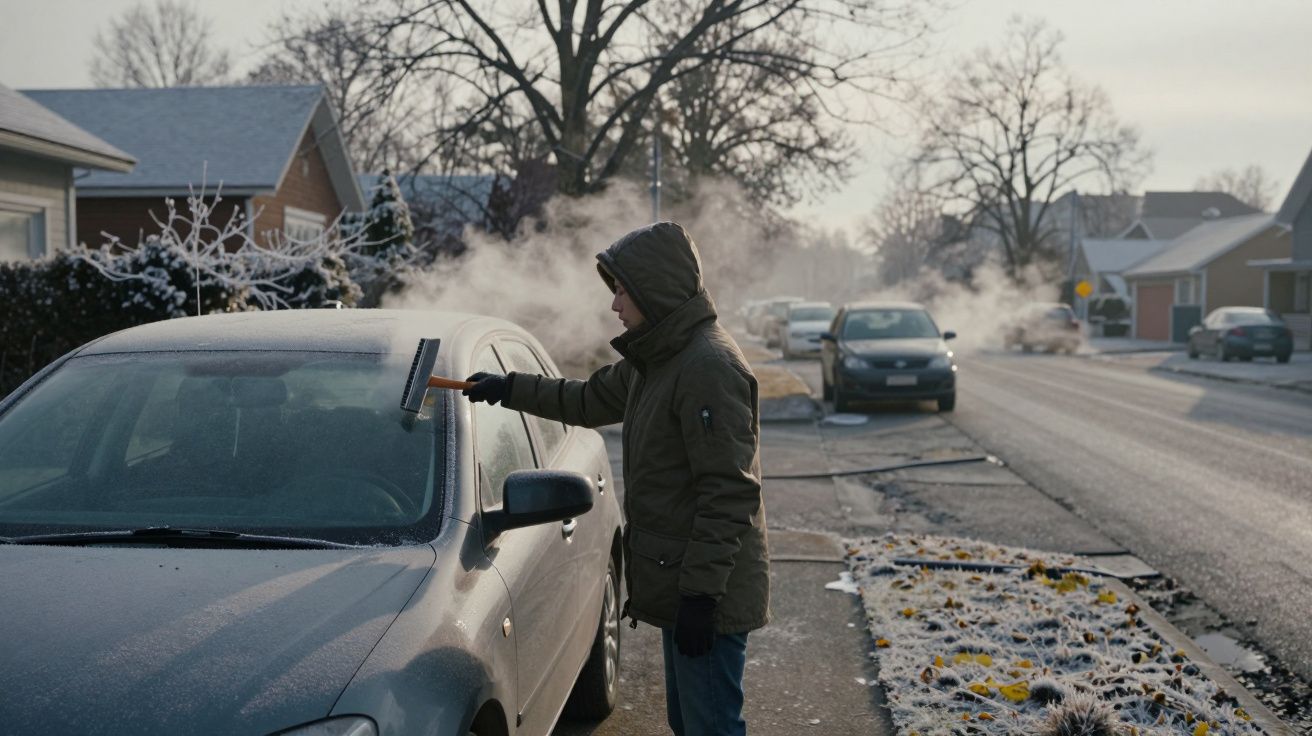
On a white-breathed January morning, the street sounds different. No birds yet, just the low rumble of cold engines ticking over in driveways. A line of cars sits shivering under frost, each with a faint plume of exhaust hanging in the still air. You turn the key, hear the starter catch, nudge the heater to red and step back with the scraper. The advice echoes in your head: “Let it warm up a bit, it’s better for the engine.”
Across the road, a neighbour pulls out in silence in an electric car, cabin already mist-free. Your windscreen is half-cleared, the steering wheel still icy, and the fuel gauge nudges down a notch before you’ve moved an inch. It feels like care. Mechanics say it looks more like slow, quiet damage.
The habit that once helped old engines now mostly hurts modern ones – and your wallet.
Why modern engines don’t need a long warm-up
Ask a seasoned mechanic about “warming up on the drive” and you’ll often get the same answer: that advice belongs to carburettors and chokes, not to today’s engines.
Older petrol cars needed time for thick winter oil to circulate and for carburettors to settle. Drivers pulled a manual choke, the engine ran rich, and a few minutes of idling stopped it stalling at the first junction. Modern fuel-injected engines simply don’t work like that.
Sensors now measure air temperature, coolant temperature and oxygen in the exhaust hundreds of times a second. The engine control unit adjusts fuel and ignition automatically. Oil pumps are more efficient, tolerances are tighter, and lubricants are blended specifically for cold starts.
“On anything built in the last 20 years, the quickest, healthiest way to warm it up is to drive gently,” says one independent technician. “Idling on the spot just delays that and burns fuel for nothing.”
When you drive off within 30 seconds or so and keep revs low, the engine reaches its ideal temperature faster than it ever will sitting on the drive. That matters, because engines are designed to operate at temperature – not on the way there.
What idling really does to your car
The quiet myth is that an idling car is simply “resting and warming”. Under the bonnet, something very different is happening.
- Fuel wash-down: Cold engines run rich for a short period. Let them sit idling like that and excess fuel can wash the thin film of oil from cylinder walls, increasing wear over time.
- Incomplete combustion: At low revs, especially in diesels, the burn is less efficient. That can lead to more soot and deposits in the exhaust and on sensors.
- DPF stress in diesels: Diesel particulate filters (DPFs) hate prolonged idling. They need heat and flow to regenerate. Lots of short, cold idling spells are a fast track to clogging – and expensive warning lights.
- Exhaust condensation: Moisture builds up in a cold exhaust system. If journeys are short and preceded by long idling, water may never fully evaporate, encouraging corrosion from the inside out.
- Battery and alternator load: Heaters, blowers, heated screens and lights draw heavily when the alternator is turning slowly. A weak battery on a winter morning doesn’t thank you for sitting still with everything on.
None of this will destroy an engine overnight. But multiplied across winters, years and school runs, the wear and tear add up.
Warmth doesn’t come from waiting; it comes from moving.
The hidden cost: fuel, money and air you breathe
Because the car isn’t going anywhere, idling can feel like “free” heat. The numbers tell another story.
A typical modern petrol car can burn roughly 0.8–1.0 litres of fuel per hour at idle once settled; larger diesels can use more. On a frosty morning, ten minutes here and there looks small, until you stretch it across a season.
| Time idling per day | Approx. fuel per week* | CO₂ emitted per week* |
|---|---|---|
| 5 minutes | ~0.6 litres | ~1.4 kg |
| 10 minutes | ~1.2 litres | ~2.8 kg |
| 15 minutes | ~1.8 litres | ~4.2 kg |
*Indicative figures for a single medium petrol car; real use varies.
Scale that to a busy street or a school gate and the quiet waste becomes harder to ignore. Every idling engine is pumping exhaust at ground level, right where children on footpaths and pushchairs are breathing. Nitrogen oxides and particulates don’t care that you’re only “waiting a minute”.
There’s also the legal side. Local authorities in the UK have powers to fine drivers who refuse to switch off unnecessary idling, especially near schools. The Highway Code is clear: if you’re parked, you should generally switch off the engine and apply the handbrake.
“We see parents sat outside the workshop with the engine running for 20 minutes on the phone,” says a Birmingham mechanic. “That’s half a litre of fuel, a fog of fumes, and the car still isn’t properly warm.”
“But I need to clear the windows”
This is the most understandable reason people give for idling, and the one mechanics are keenest to reframe, not dismiss. You absolutely must not drive off with misted or frosted glass. The question is how you clear it.
A better routine looks like this:
Start the engine, set the heater and fans correctly.
Direct air to the windscreen, use the air-con or dedicated demist setting if you have it, and turn on heated screens and mirrors.Stay put for 30–60 seconds.
This gives oil a brief moment to circulate and lets fans and heaters wake up – you don’t need five to ten minutes.Use physical tools for the heavy lifting.
- A good ice scraper and de-icer spray can clear glass faster than an idling heater.
- A winter windscreen cover the night before means almost no scraping in the morning.
- A good ice scraper and de-icer spray can clear glass faster than an idling heater.
Clear every window, not just a letterbox.
Side and rear visibility are as vital as the view ahead. Snow or heavy frost on the roof should go too, so it doesn’t slide forwards under braking.Drive off gently as soon as you can see safely.
Keep revs low for the first few miles and avoid hard acceleration until the temperature gauge begins to climb.
This approach balances safety with mechanical sympathy. The engine warms quickly under light load, the cabin demists fully in motion, and you’re not paying to heat the street.
Special cases: diesels, turbos and electric cars
Not all powertrains respond to cold in the same way, and that feeds some of the confusion.
Modern diesels
Often take longer to blow warm air, which tempts drivers to idle even more. The catch is that diesels soot up more readily at low temperature and low revs. For DPF health, short idling is worse than gentle driving.Turbocharged engines
Turbos are now so common that old advice still floats around about warming and cooling them. In winter, you don’t need to idle a turbo car on the driveway; you need to avoid heavy boost until everything’s warm. The cool-down story is separate and mostly relevant after sustained hard driving, not a school run.Hybrids and EVs
These are built with pre-conditioning in mind. If you can, set a departure time while the car is plugged in: it will warm (or cool) the cabin using mains power, not your fuel tank or traction battery alone. There is no mechanical benefit to “warming up” an electric motor at a standstill.
“If your car can pre-heat from the app, use it,” notes one dealer technician. “If it can’t, a £10 windscreen cover gets you 90% of the way there without burning a drop more fuel.”
A cold-morning routine that’s kind to your car (and everyone else)
You don’t need to become the perfect winter driver overnight. A few small tweaks remove most of the wear and waste:
Prepare the night before when frost is forecast.
Fit a windscreen cover, park facing the morning sun if possible, and put scraper and de-icer where you can reach them without opening every frozen door.Limit idling to what’s genuinely useful.
Think 30–60 seconds, not ten minutes. Long enough for fluids to move and fans to start, short enough to avoid rich, cold running on the spot.Drive smoothly until warm.
Use higher gears earlier, avoid full-throttle overtakes, and accept that heaters take a mile or two to reach full power.Switch off when stopped.
In queues, at rail crossings, outside schools or shops, handbrake on and engine off if you’re waiting. If your car has stop–start, let it do its job unless conditions make it unsafe.Check your battery and coolant before winter bites.
A weak battery will struggle most on cold, short trips; a proper coolant mix protects both engine and heater performance.
The aim isn’t martyrdom at –3°C. It’s a routine where comfort, safety and mechanical health all point in roughly the same direction.
Who still needs a longer warm-up?
There are a few exceptions, but they’re rarer than people think.
Classic cars with carburettors, manual chokes or very basic fuel systems often do benefit from a short, careful warm-up before driving off. Commercial vehicles with specific equipment (like PTO drives) may have manufacturer guidance that involves idling. High-performance engines on track days are their own category entirely.
For the average family car built this century, however, the “ten minutes on the drive” ritual is more habit than help.
| Habit | What you think it does | What it actually does (modern cars) |
|---|---|---|
| 10+ minutes idling to warm up | Protects the engine, clears the screen | Slows warm-up, increases wear and soot, wastes fuel |
| Driving off gently after ~30s | “Bad for the engine” | Warms engine and cabin faster, improves efficiency |
| Leaving engine on while parked | Keeps heater going “for free” | Burns fuel for no movement, adds local pollution |
FAQ:
- Do I ever need to warm up before moving?
Yes, but briefly. Start the engine, give it 20–30 seconds for oil to circulate and systems to settle, then drive off gently. That’s enough for the vast majority of modern cars in UK winters.- What about in very severe cold, below –10°C?
In extreme cold snaps, you might stretch that to a minute or two, especially if the car has been sitting for days. The key is still to keep idling time reasonable and avoid hard acceleration until everything is warm.- Is it illegal to idle on my drive?
Idling on private property is treated differently to public roads, but local by-laws and anti-idling campaigns often focus on streets, school gates and lay-bys. Regardless of fines, the mechanical and environmental downsides are the same.- My windscreen fogs as soon as I set off. What can I do?
Use the air-con with the heater (it dries the air), choose fresh air rather than recirculate, and clear wet mats or leaks that add moisture. A clean interior glass surface also resists fogging better.- If idling is bad, why do some cars have remote start?
Remote start is usually a comfort feature for markets with harsher winters. It doesn’t change the physics: extended idling still burns fuel and slows warm-up. If you use it, keep the preheat window short and combine it with good scraping and covers.






Comments (0)
No comments yet. Be the first to comment!
Leave a Comment