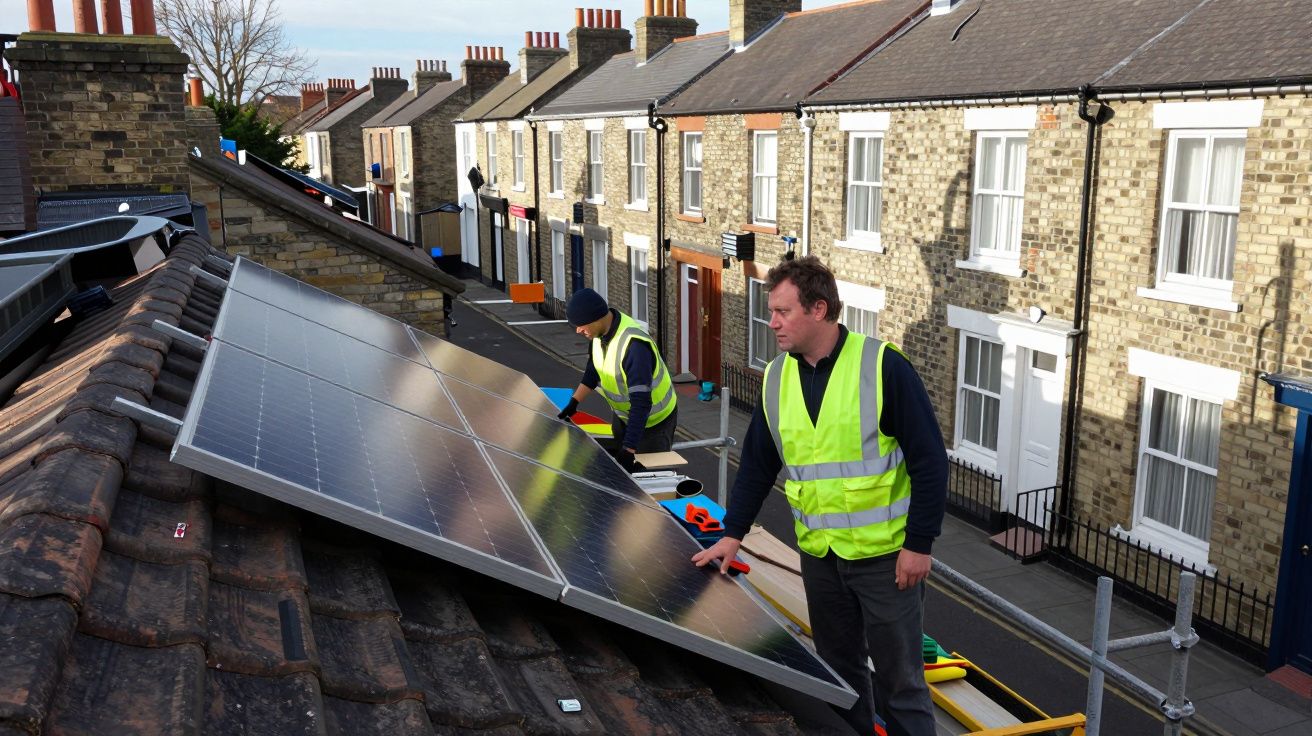
At 10 a.m. on a narrow terraced street in Leeds, the scaffolding is already up. A crew in high‑vis vests hauls shiny black panels up to the roof, fixing them neatly in two rows that follow the tiles like a second skin. The homeowner watches from the pavement, imagining their electricity bills quietly shrinking with every bracket that goes in.
Six months later, the bills have fallen - but not as much as they’d hoped. An engineer, called in after a chat with a more smugly satisfied neighbour, opens their laptop and pulls up the generation data. The numbers are fine on paper. Yet when they run the same system through a simulator with one small tweak - a slightly steeper tilt on the panels - the graph jumps.
Same roof. Same street. Same sunshine. Up to 15% more power, lost because the panels were laid at the wrong angle.
No one mis‑wired anything. No one used the wrong brand of inverter. The mistake is quieter than that. On thousands of terraced roofs across the UK, panels have been installed in the easiest position, not the best one. And over 20–25 years, that quiet shortcut adds up to a lot of wasted watts.
What engineers keep finding on British terraces
Walk down a Victorian terrace in Manchester, Bristol or Glasgow and you’ll see the pattern. Chimneys, satellite dishes and a scattering of solar arrays all marching along the ridge line. Many of those systems work perfectly well. But when engineers audit them - usually because a curious owner wonders why their output seems low - the same design flaw appears again and again.
Panels are mounted to match the roof pitch by default, even when that pitch is a long way from the sweet spot for solar in the UK.
On classic older terraces with steep, south‑facing roofs (around 35–40°), that lazy habit doesn’t hurt much. The roof itself happens to be close to optimal. The problems show up on:
- Shallow‑pitched rear extensions tucked behind the main terrace.
- Loft conversions with almost flat dormer roofs.
- Mid‑terrace properties where planners pushed for a very low profile, so installers laid panels almost flat to “keep the neighbours happy”.
In those cases, the difference between “what fits easily on the roof” and “what actually points at the Sun most of the year” can translate to a 10–15% hit on annual yield. On some very shallow roofs, it’s more.
Across hundreds of system checks, consultants report the same pattern: angle errors are one of the top avoidable causes of under‑performance, second only to shading from chimneys and nearby buildings.
The geometry quietly stealing your watts
The basic physics is not complicated. In the UK, a fixed solar panel typically performs best when it’s tilted at roughly the same angle as your latitude - around 35–40° for much of England, a bit steeper further north. That angle balances summer and winter Sun, giving you a good spread of output across the year.
What actually gets built on terraced roofs is often quite different:
- Extensions with 10–15° pitches where panels are bolted flush to the surface.
- Flat roofs where panels are tilted just 5–10° to stay below a parapet or avoid being seen from the street.
- South‑east or south‑west roofs where nobody adjusts the tilt or layout to compensate for the off‑south orientation.
A panel that’s 15–20° too shallow still produces power, especially in high summer, but it sheds winter performance. At UK latitudes, that can knock around 8–15% off your yearly generation compared with a well‑angled array on the same roof.
There’s a second, less obvious penalty. Shallow panels don’t shed grime and standing water as effectively. Dirt builds up. Puddles linger after rain. Over time, that can nibble away another few per cent of output unless the array is cleaned more often.
The result feels like a small “sunshine tax”: you pay the full price for the system, but you only ever collect 85–90% of what your roof could have earned.
How much does a 15% angle error really cost?
Engineers like to translate percentages into something you can feel. Consider a fairly typical terraced‑roof system:
- 3.6 kWp array on a mid‑terrace in the Midlands.
- Good, unshaded aspect.
- Properly sized inverter, decent cables, no obvious faults.
On a well‑angled south‑facing roof, that system might generate around 3,200–3,500 kWh per year. Mounted too shallow or nearly flat, it could drop to something like 2,800–3,000 kWh.
That 10–15% gap is:
- Roughly 300–500 kWh per year.
- At 25–30p per kWh, around £75–£150 of lost savings every year.
- Over a 20‑year lifespan, easily £1,500–£3,000 of electricity you never harvest - without counting any future price rises.
On a street where two neighbours have similar houses, similar systems and similar habits, that’s the difference between one person feeling delighted and the other quietly puzzled.
The classic angle mistakes on terraced roofs
When solar engineers talk about “angle mistakes”, they’re not imagining everyone clambering up to install complex tracking systems. They mean a handful of very ordinary design decisions that, on terraces, keep repeating.
1. Treating flat roofs like pitched roofs
On many terraces, the most convenient space is the flat or almost‑flat rear roof above a kitchen or bathroom. To keep costs down and lines clean, installers often:
- Lay panels at 5–10° on simple trays or low‑profile rails.
- Pack rows closely together, so steeper tilts would cause panels to shade each other in winter.
- Avoid higher frames because of wind‑load concerns or planning worries.
On paper, these arrays tick the boxes. In a simulator, the same roof with panels lifted to 20–30° - and rows spaced properly to avoid self‑shading - often shows 10–15% more annual output.
2. Letting aesthetics overrule physics (without saying so)
Residents’ associations, conservation officers and neighbours don’t always love the look of tilted frames on a neat terrace. The compromise is predictable: “We’ll just keep the panels snug to the roof so they’re barely visible.”
That can be a fair trade‑off if everyone understands the cost. Too often, nobody spells it out. The homeowner signs for “X kWh per year” in the paperwork, not realising that the same budget could have delivered more if the design had allowed a slightly higher tilt or a staggered layout.
3. Ignoring the orientation–tilt combo
A south‑east or south‑west roof can be perfectly viable for solar. But if it’s already off‑south, flattening the tilt as well compounds the loss. On terraces, you sometimes see:
- South‑east roofs at 20° where a 35–40° tilt would recover some winter morning Sun.
- West‑facing dormers with very shallow pitches that favour summer evenings but starve the system the rest of the year.
The mistake isn’t having an east‑ or west‑facing roof; it’s failing to use the tilt you do control to claw back performance.
A quick sense‑check: is your roof likely affected?
Before you panic, most well‑installed arrays on classic pitched terraces are absolutely fine. Angle errors that really sting tend to appear in certain situations.
You might be losing out significantly if:
- Your panels sit on a roof that looks almost flat from the street.
- You can barely see the panels at all above the parapet or gutter line.
- Rainwater sometimes pools near the bottom frame when you look from an upper window.
- Your system consistently generates noticeably less than neighbours’ arrays of similar size and orientation.
You’re probably in good shape if:
- Your main array sits on a south‑facing pitch between roughly 30° and 40°.
- The panels look clearly “leaning” rather than nearly horizontal.
- An independent calculator (from your installer or an online tool) matches your annual output within 5–10%.
How to fix or avoid angle errors in real life
Not every roof gives you a perfect south‑facing 35° canvas. The aim is not perfection, but a design that makes the most of what your terrace actually offers.
If you’re planning a new installation
Before you sign anything, ask your installer to show:
- A yield estimate for at least two different tilts on your roof, not just “flush with the surface”.
- How close the proposed design gets to the optimum angle for your location.
- Any planning or structural reasons they can’t use a better tilt.
Good installers will also:
- Check row spacing on flat roofs so one row doesn’t shadow the next in winter.
- Use mounting frames that add tilt where it’s safe to do so.
- Explain, in plain numbers, the trade‑off between aesthetics, planning limits and performance.
If you live in a conservation area or under a strict residents’ covenant, you can still ask: “If we keep the very low profile you’re suggesting, how many kWh per year am I giving up?” That turns a vague design choice into a clear decision.
If you already have panels on a terraced roof
Retrofitting tilt is not always practical, but it’s often worth checking. A reputable engineer or surveyor can:
- Measure your current tilt and orientation accurately.
- Run a simple “what if” model for a better angle on the same roof.
- Check for shading from chimneys, TV aerials and neighbouring roofs at different times of day.
Possible fixes include:
- Adding modest tilt frames on flat roofs, if wind loading and parapet height allow.
- Re‑spacing or re‑orienting rows to reduce self‑shading and allow a steeper pitch.
- Moving a small rear‑roof array to the main pitched roof, if structure and planning permit.
Sometimes the answer will be: “You’d gain 5%, but you’d spend more on scaffolding than you’ll recoup.” Other times, especially for very flat arrays with 15–20 years of life left, the maths of a re‑tilt can be surprisingly favourable.
Common roof types, typical issues and impact
| Roof type on a terrace | Typical angle issue | Potential impact |
|---|---|---|
| Main pitched, south‑facing (30–40°) | Panels mounted flush – usually fine | Minimal; maybe 0–5% from non‑ideal pitch |
| Flat rear extension | Panels at 5–10° to stay hidden | 10–15% annual loss + more dirt build‑up |
| Shallow SE/SW loft conversion | Low pitch and off‑south orientation | 8–15% loss vs a steeper, better‑aligned design |
The point isn’t that every shallow roof is a disaster. It’s that knowing the likely loss lets you decide whether the compromise is worth it.
Simple rules of thumb for terraced homes
You don’t need to become a solar designer to avoid the worst angle mistakes. A few quick guidelines go a long way:
- Aim for 30–40° tilt where possible. If your roof is in that range and faces due south, mounting panels flush is usually acceptable.
- On flat roofs, question very low tilts. If you’re offered 5–10° purely for appearance, ask to see the performance hit in kWh.
- The further from south you point, the more tilt matters. East‑ and west‑facing roofs benefit from a bit more tilt to catch low‑angle Sun.
- Don’t pack rows too tightly. If one row’s shadow hits the next for long stretches in winter, angle benefits are partly wasted.
- Write trade‑offs down. If aesthetics or planning force a sub‑optimal angle, get the lost yield quantified in the proposal.
That way, if you accept an angle compromise, it’s a conscious choice - not a surprise baked into your bills for 20 years.
FAQ:
- What is the “best” angle for solar panels in the UK? For fixed panels, a tilt close to your latitude (roughly 35–40° for much of England and Wales, a bit more in Scotland) is a solid starting point. Installers may tweak that depending on whether you care more about summer or winter output.
- Is it always worth changing an existing array’s angle? Not always. If your panels are already on a 25–35° south‑facing roof, the gain from a small adjustment might be only a few per cent - easily swallowed by scaffolding and labour costs. The biggest wins tend to be on very shallow or flat roofs.
- My panels are nearly flat on a rear extension. Should I be worried? Not necessarily, but it’s worth getting a quick assessment. A modest tilt increase on a flat roof can deliver 10–15% more energy if done safely, especially if your system is otherwise unshaded and in good condition.
- Do micro‑inverters or optimisers fix angle problems? They can reduce losses from shading and mismatch between panels, but they don’t change the basic geometry. A poorly angled array with micro‑inverters is still pointed at the wrong bit of sky - just more intelligently.
- What should I ask a potential installer about angle? Ask for your roof’s measured pitch and orientation, the predicted annual yield at that angle, and a comparison with a more optimal tilt if one is possible. Request that any constraints (planning, wind loading, aesthetics) and their impact on kWh are spelled out in the design.




Comments (0)
No comments yet. Be the first to comment!
Leave a Comment