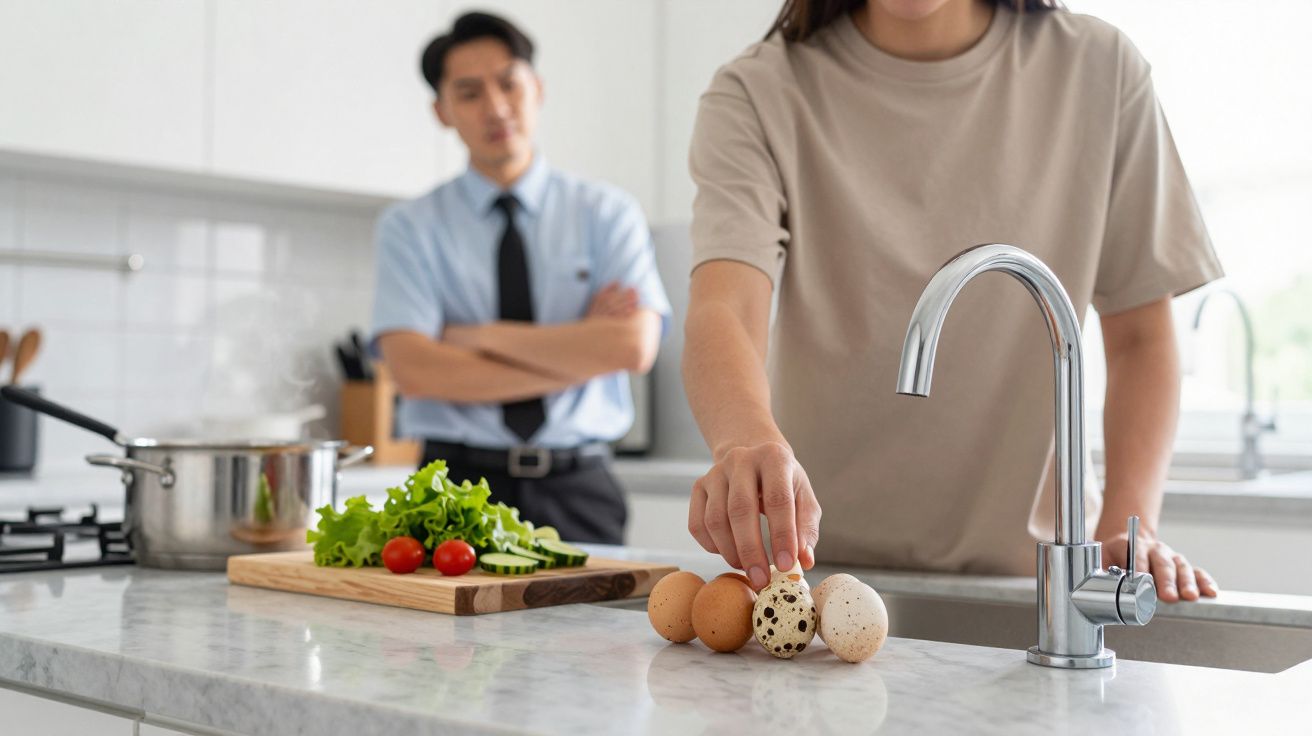
Steam curled from the saucepan, toast popped in the corner, and a half-dozen speckled shells waited by the sink. Someone reached for the tap on autopilot, thumb flicking it on before their brain caught up. A soft rush of water, a quick rub of the shell, a shake over the basin. It felt like “being careful” - the same way rinsing an apple does - until the food safety inspector cleared her throat.
She didn’t shout. She just watched the water bead and run, carrying whatever sat on that shell straight into the sink, across the draining board, towards a chopping board stacked with salad. “That one little rinse,” she said, “is how a good brunch turns into a bad night.”
We think of eggs as harmless because they arrive in cardboard trays, stamped with neat little dates and friendly lion logos. The box spends a week on the worktop, we break, whisk, dip bread into yolk, and no one gets ill - most of the time. So the habit of rinsing under the tap feels like extra hygiene, a belt-and-braces move. It isn’t.
The surprise is simple and a bit uncomfortable: water on an eggshell does not “wash danger away.” It helps it travel. Across your hands, your tap, your tea towel. In some cases, into the egg itself.
Why inspectors wince when you rinse an egg
An eggshell looks solid, but under a magnifier it’s a maze of pores and tiny faults. Nature covers that with a thin invisible film called the cuticle - a protective varnish that keeps bacteria out and moisture in. UK producers are not allowed to wash table eggs for exactly this reason: heavy washing strips that shield away.
At home, when you run an egg under the tap, two things happen inspectors care about:
- Splashback. Tiny droplets bounce off the shell and into your sink, onto nearby food, utensils and your hands. If there’s Salmonella or other bacteria on the surface, you’ve just given it a taxi.
- Temperature shift. If the rinse water is warmer than the egg, it can create gentle suction through those pores. Bacteria on the shell get a nudge inward, where they’re harder to kill unless you cook the egg properly.
We’ve all had that moment where you spot a smear of dried muck and think, “I’ll just give this one a quick clean.” The instinct is tidy. The effect, from a microbiologist’s point of view, is chaos.
Food safety teams quietly repeat the same line in kitchens across the country: don’t wash eggs – handle them cleanly instead. It feels backwards until you understand what’s actually sitting on that shell.
What really lives on an eggshell
Healthy, well-produced eggs are low risk, especially UK Lion Mark eggs, where hens are vaccinated against Salmonella and farms are inspected. “Low risk” isn’t “no risk,” though, and the shell is where any trouble usually starts.
Typical passengers on a dirty shell include:
- Salmonella and other gut bacteria from the hen or the environment
- Dust, dried faeces and bedding from the hen house
- General kitchen contamination from your hands or surfaces
The shell is meant to be the outer barrier, not something you tidy up later. Once it’s contaminated and wet, two routes open:
- Into your sink and onto your stuff – where salad veg, sponges and cloths pick it up with ease.
- Through the shell – especially if the egg is cracked, very fresh and warm, or the water is much warmer than the egg.
Let’s be honest: nobody actually lines up eggs for a forensic shell inspection. They’re quick, everyday food. That’s exactly why the rules are blunt. Keep the shell dry. Keep it away from ready-to-eat foods. Cook what’s inside properly.
The safer way to deal with a dirty egg
You’ve cracked open the box and one egg looks like it’s been in a rugby scrum. The old reflex says “sink, tap, rub.” The safer script is quieter:
- If an egg is heavily soiled or cracked, bin it. It feels wasteful, but it’s cheaper than food poisoning.
- For light dirt, dry-wipe instead of wash. Use a piece of kitchen roll or a clean, dry brush to gently flick off bits. Then throw the paper away and wash your hands.
- Keep dirty shells away from food prep. Break eggs in a separate bowl, not directly into the pan or batter, so any stray shell or dribble stays contained.
In commercial kitchens, inspectors often encourage a “shell zone”: one small area, one bowl, one bin, then handwashing before anyone touches salad or plating. At home, that can be as modest as cracking eggs on a board you’ll wash straight away, not over the frying pan hovering above your toast.
Simple kitchen rules that make eggs safer
You don’t need new gadgets or special sprays. You need a short, boring list that becomes your new automatic habit.
- Don’t wash eggs under the tap. Not before storage, not before cracking, not “just this once.”
- Store eggs in the fridge in their box. The box protects them from knocks and smells, and the cool, steady temperature slows bacterial growth.
- Use eggs by the “best before” date. After that, quality drops and the margin for safety narrows.
- Wash hands and wipe down. After handling raw eggs or shells, scrub your hands with soap and hot water, and clean the worktop and tap you touched.
- Separate eggs from ready-to-eat foods. Keep egg handling, cracking and whisking away from salads, fruit, bread and anything you don’t plan to cook.
- Cook properly for higher-risk people. Pregnant women, young children, older adults and anyone with a weakened immune system are safer with thoroughly cooked eggs and no raw mixtures.
Think of it less as “be scared of eggs” and more as “treat eggshells like raw chicken packaging” - something you don’t rinse, cuddle or wave near your lettuce.
What actually happens when you cook
Heat is the great leveller. If there are bacteria present, proper cooking will deal with them, but it has to be enough heat in the right places.
- For dishes like omelettes and scrambled eggs, cook until they are steaming hot and no liquid egg remains.
- For boiled eggs, UK advice allows runny yolks if they are Lion Mark and you’re not in a higher-risk group.
- For home-made mayonnaise, tiramisu, mousse or any raw-egg dish, use pasteurised egg products or Lion Mark eggs and avoid serving to vulnerable guests.
What cooking can’t fix is contamination that’s already spread to your salad leaves, chopping board or ready-to-eat ham because you rinsed a muddy egg over them half an hour earlier. That’s the gap the “no rinsing” rule quietly closes.
A quick guide to egg safety at a glance
| Point | What to do | Why it matters |
|---|---|---|
| Shell hygiene | Don’t wash; dry-wipe or discard dirty eggs | Stops bacteria spreading via splashes or pores |
| Storage | Keep in the fridge, in the original box | Protects the cuticle, keeps temperature steady |
| Handling | Crack in a separate bowl, then wash hands | Keeps shells away from ready-to-eat food |
These are small, almost dull habits. They’re also the habits that mean you can keep enjoying soft-boiled soldiers without worrying what’s lurking in the sink.
If you’ve always rinsed eggs, what now?
Habits sit in muscles more than in minds. You may have rinsed eggs for decades without noticing a problem, because the odds on any single egg are low. Inspectors don’t argue with your history; they argue with the maths.
The fix is not panic. It’s a quiet pivot:
- Stop the rinsing from today.
- Treat your sink, tap and favourite cloth as if raw egg has visited them - wash or change them more often.
- Put egg handling on the same mental shelf as raw meat: short, tidy, followed by soap.
You won’t see anything different. That’s the point. Food safety wins are invisible, measured in non-events: the birthday party where no one is ill, the lazy Sunday breakfast that ends with a nap, not a pharmacy dash.
FAQ:
- Is rinsing eggs ever recommended at home? No. In the UK, food safety guidance is clear: don’t wash eggs. It increases the risk of spreading bacteria and can damage the natural protective coating on the shell.
- What if an egg from my own hens is muddy? Home-laid eggs should still not be washed under the tap. Dry-clean them with kitchen roll or a clean abrasive pad, discard heavily soiled ones, and store in a cool place. For vulnerable people, cook backyard eggs thoroughly.
- Are Lion Mark eggs completely safe to eat runny? For most healthy people, yes - that’s the current advice. Pregnant women, young children, older adults and those with weakened immune systems are safer with fully cooked eggs.
- Can I sanitise eggs with vinegar or special washes? Chemical or vinegar washes at home can strip the cuticle just like water does, and don’t guarantee full disinfection. They’re not recommended for routine use on shell eggs in domestic kitchens.
- Is it safe to leave eggs on the worktop? Short spells while cooking are fine, but for storage the fridge is safer. A steady cool temperature slows any bacterial growth better than a warm kitchen counter.


Comments (0)
No comments yet. Be the first to comment!
Leave a Comment