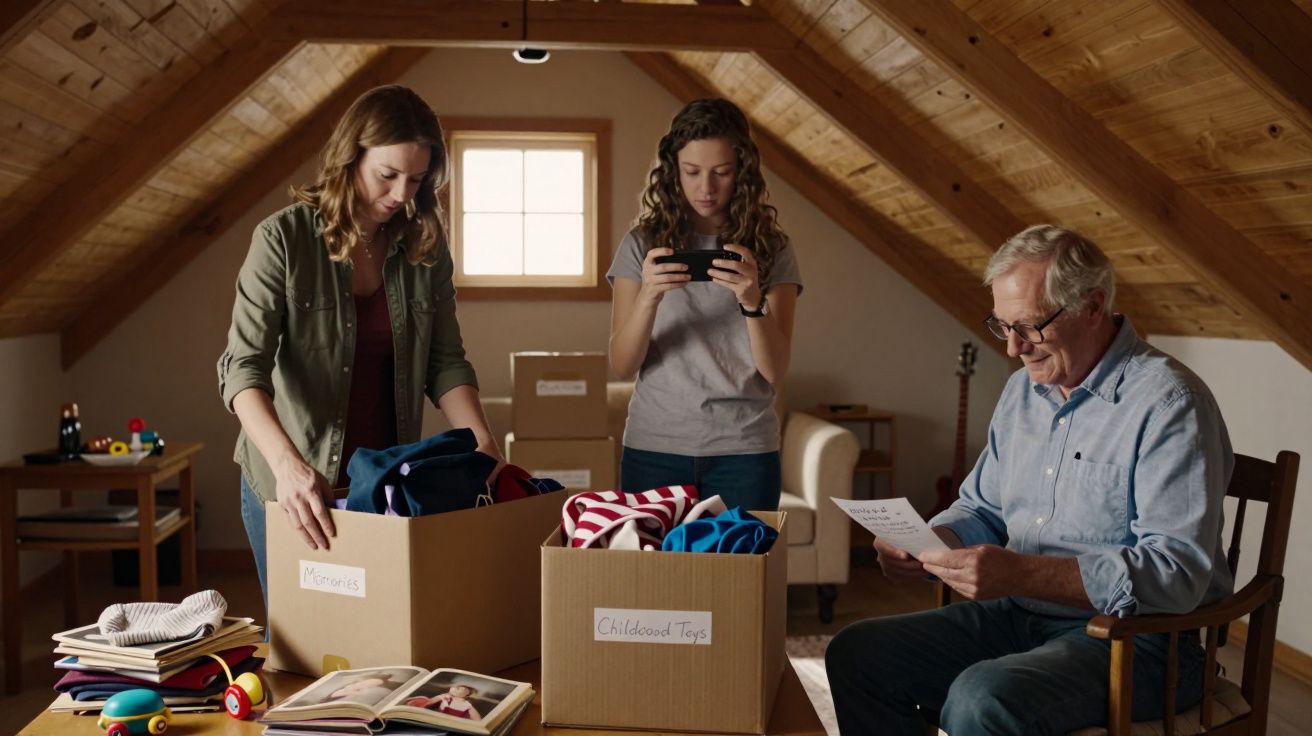
Lofts fill up slowly, then all at once. A few baby clothes, a box of exercise books, Nan’s side plates, the cot “just in case” – and suddenly the hatch hides a museum that no one quite dares to open. The space is needed, yet one person’s “old junk” is another person’s link to a parent, a marriage or a country they left long ago.
This is exactly where family rows start. Someone touches the wedding dress; someone else says, “Over my dead body”, and the day collapses into sulks and bin bags that quietly migrate back upstairs. Professional organisers don’t turn up with superior willpower. They turn up with a rule that changes the question from “Do we care?” to “Which way do we want to care?”
The rule many of them lean on is simple and surprisingly kind: no sentimental item leaves the loft unless its story is kept in some way. That becomes the spine of the whole day.
The Keep–Capture–Clear rule, decoded
The Keep–Capture–Clear rule gives every sentimental object three possible fates instead of a brutal keep-or-bin ultimatum.
- Keep: The physical item stays, but in a clearly defined “memory container” with a limit.
- Capture: The memory is preserved (photo, video, voice note, short text) and the object goes.
- Clear: The item is released without extra ceremony because no one claims it as meaningful.
Nothing with emotional weight is thrown away in silence. Either it is kept with intention, or its story is captured before it goes.
Two things make this work in real lofts:
- Containers, not infinite space. Each person gets a set volume for keeps (for example, one or two lidded archive boxes). Once it’s full, choosing to keep something new means letting something else go.
- A shared rule, agreed before you open a single box. You decide together what “keep”, “capture” and “clear” look like for your family, then you stick to it.
The aim isn’t to talk people out of being sentimental. It’s to give that sentiment a shape and a boundary so the loft can breathe again.
Why this rule stops rows before they start
Arguments over sentimental stuff are rarely about the item in someone’s hand. They’re about being scared the memory will vanish, or feeling someone else is “deciding your history” for you. The rule answers that directly.
- Everyone gets a guaranteed safe zone. Those memory boxes are sacred. No one else edits them.
- The story is always saved. A dress can go to charity, but a photo of mum in it, plus a 30‑second voice note of the story, stays.
- Decisions feel fair, not personal. You’re not saying, “Your childhood doesn’t matter.” You’re saying, “We’ve agreed the limit. Within it, you choose.”
“We’re not throwing your memories away. We’re deciding the best way to keep them.”
It also shifts the energy from accusation (“You keep everything”) to collaboration (“We all work within the same rule”). People are far less defensive when they know their non‑negotiables have a home.
How to use it in a real loft, step by step
You’ll move faster – and argue less – if you set things up before you even climb the ladder.
1. Set the ground rules together
Gather the family members who share the loft and agree:
- How many memory boxes each person gets (size and number).
- What counts as sentimental (letters, heirlooms, baby items, medals; not random cables).
- What your capture method will be:
- Photos on a shared album?
- Short videos talking through the item?
- A simple “family archive” notebook?
Decide this at the kitchen table, not halfway through an argument at the hatch.
2. Create the stations
Before you start pulling things down, set up:
- A KEEP area – with one labelled box per person.
- A CAPTURE area – phone on charge, neutral background for photos, maybe a small tripod.
- A CLEAR area – strong bags for charity, recycling and rubbish.
- A MAYBE LATER box – for tricky items to revisit once everyone is tired.
The rule still applies to the “maybe later” pile; you’re just postponing the call.
3. Clear the easy wins first
Don’t start with the wedding album. Start with:
- Broken, mouldy, or clearly unusable items.
- Duplicate kitchenware, spare duvets, random electronics, boxes with no contents.
- Paperwork that’s out of date and not legally important.
This warms everyone up, proves that progress is possible and builds trust before you touch anything emotionally loaded.
4. Move to sentimental items with the script ready
For each item that might have a story, ask three questions:
- Whose memory is this? (They get first say.)
- How often will we realistically use or touch it?
- Would a photo or short story feel enough, or do we need the physical thing?
Then apply the rule:
- If the owner lights up and there’s room: Keep.
- If they want the story but don’t need the object: Capture then Clear.
- If no one claims it: Clear – or at most, place in Maybe Later with a date to revisit.
Work in short bursts: 45 minutes on, 15 minutes off. Emotional decisions are heavier than physical ones.
5. Honour what you keep
Sentimental “keeps” deserve better than being flung back in dusty boxes.
- Use archival boxes or lidded plastic crates with labels.
- Put a short note inside if the story is not obvious (“Grandad’s RAF jacket, 1943, kept by Sam”).
- Store photos and videos in a shared digital folder labelled by person or decade.
You’re not just saving space; you’re creating an archive the next generation can actually understand.
Scripts that ease tricky moments
Words matter when feelings run high. A few prepared phrases can calm the temperature.
- Instead of “We don’t need this”, try:
“Is this one you’d like to keep in your box, or would a photo and the story feel enough?” - Instead of “It’s just clutter”, try:
“I can see this means a lot. How can we keep the memory in a way that doesn’t keep the loft full?” - When someone hesitates, try:
“Shall we pop it in the ‘maybe later’ box and decide after a cup of tea?” - When you’re the sentimental one, try:
“This one’s non‑negotiable for me. I’ll make space in my box for it.”
The goal isn’t to win. It’s to keep the conversation about choices and trade‑offs, not about whether someone is “too attached” or “too ruthless”.
Adapting the rule for different family set‑ups
Every loft has its own politics. The rule flexes if you tweak who decides, and when.
| Situation | Tweak | Why it helps |
|---|---|---|
| Elderly parent’s loft | Let them choose keeps; you focus on capture & clear | Respects autonomy while moving volume out |
| Blended families | One memory box per person, clearly labelled | Avoids “your stuff vs my stuff” arguments |
| Recently bereaved | Start with capture; delay clear for 6–12 months | Gives space for grief without freezing the loft |
If someone can’t face the loft emotionally, they can still take part by recording stories from the sofa while another person does the lifting and photographing.
Common pitfalls (and how to dodge them)
- Secret binning. Throwing things away behind someone’s back almost always backfires. Use the rule in the open, even if it’s slower.
- Letting the “maybe later” box breed. Limit it to one container. When it’s full, you must empty it before you add more.
- No limits on keeps. Without a container boundary, “keep” quietly means “everything”. Boxes give you a physical line in the sand.
- Trying to do it all in a day. Big lofts often need two or three sessions. Book dates in the diary rather than forcing a marathon.
If you’re stuck on an item for more than two minutes, it’s a sign the system needs tightening, not that you’re hopeless at decluttering.
When to bring in a professional
An external organiser is not there to bully you into throwing things out. They’re there to:
- Hold the rule steady when emotions spike.
- Keep pace and timings realistic.
- Mediate gently when old family patterns appear.
If conversations are already fraught, agreeing the Keep–Capture–Clear rule with a neutral person in the room can create the distance you need to get started.
FAQ:
- What if someone refuses to let anything go? Start by giving them their full memory box and filling it first. Once it’s physically full, decisions become concrete: “What would you swap out to make room for this?” That feels less like an attack and more like a practical puzzle.
- Do photos really feel as good as keeping the object? Not always, which is why “keep” remains an option. But many people find that once they have detailed photos and a short recorded story, they rarely miss the physical item – especially for bulky things like furniture or boxes of schoolwork.
- How do we handle children’s sentimental items? Let older children choose a small memory box themselves and explain the rule in simple terms: “When it’s full, you pick what matters most.” For younger children, parents can curate on their behalf, keeping a handful of representative pieces rather than everything.
- What about things that might be valuable? Set aside a small “research” pile for potential valuables and give it a deadline (for example, two weeks to check prices or ask an expert). After that, the same Keep–Capture–Clear rule applies. Otherwise, the “might be worth something” pile quietly becomes a second loft.





Comments (0)
No comments yet. Be the first to comment!
Leave a Comment