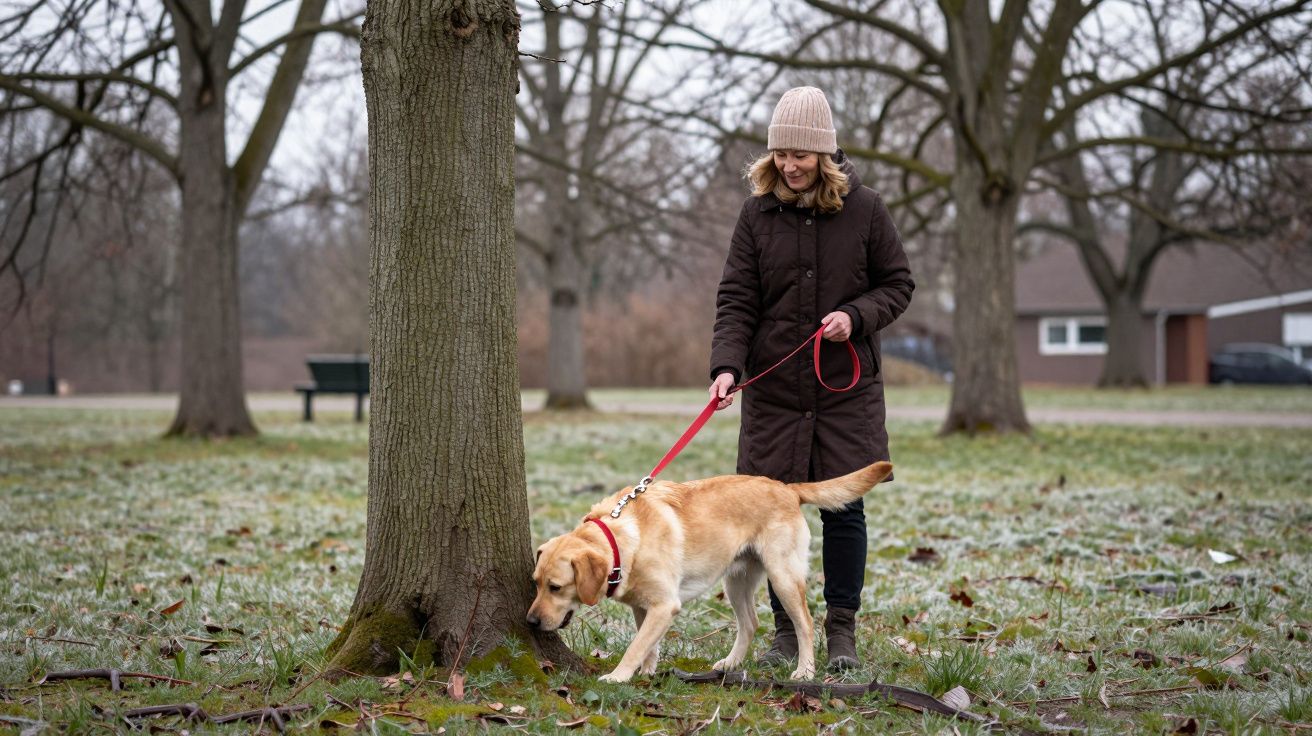
Cold air, wet pavements and slippery mud don’t just make winter walks less pleasant. For many dogs over eight, they quietly turn a normal game of fetch into a strain on ageing joints. You might notice your dog hesitating at the stairs later, taking longer to get up after a nap, or being oddly stiff the morning after an enthusiastic park session.
You don’t need to stop walking or wrap them in cotton wool. But one simple shift in how you do that winter walk can dramatically lower the wear and tear on older hips, knees and elbows – without stealing their joy.
The one change: swap “sprint and slam” walks for slow, steady, sniffy ones
If your dog is eight or older, the most protective change you can make this winter is this:
Replace high‑impact, stop–start exercise (ball throwing, sudden turns, hard sprints) with a slower, steady, sniff‑heavy walk on secure footing.
The goal is not less movement. It’s gentler, more continuous movement.
Fast chases, sharp twists and emergency stops load a lot of force into joints that are already less cushioned by cartilage. Cold muscles are tighter and slower to react, so older dogs are more likely to tweak something even doing what they’ve “always done”.
A slow, on‑lead or semi‑on‑lead walk where your dog ambles, sniffs and keeps moving steadily keeps joints lubricated, warms muscles up gradually and still gives plenty of mental stimulation.
Think of it as switching your dog from winter five‑a‑side football to winter tai chi.
Why winter hits older joints harder
Once dogs cross roughly the eight‑year mark (earlier for giant breeds), subtle arthritis is extremely common, even if nothing obvious shows on the outside.
Winter adds three stressors:
- Cold tightens muscles and stiffens joints. It takes longer to warm up, and any sudden sprint happens on a body that isn’t ready.
- Slippery or frozen ground increases sliding and twisting. One wrong step can over‑rotate a knee or strain a hip.
- Dogs naturally move less between walks. More sofa time means they start each walk from a stiffer baseline.
The combination of cold, stiffness and sudden exertion is exactly what makes “just a quick game of fetch” risky for senior joints.
That’s why changing how you walk matters more than any vitamin or gadget.
What a joint‑friendly winter walk actually looks like
You don’t need a full physio plan. A few simple tweaks turn an ordinary outing into joint care.
1. Start slower than feels normal
The first 5–10 minutes are your dog’s warm‑up:
- Keep them on lead or close at heel.
- Walk at a comfortable, steady pace.
- Avoid throwing balls or sticks, even if they’re “buzzing” to go.
You’re giving muscles, tendons and joints time to warm and loosen before any bigger movements.
2. Trade fetch for sniffing and gentle variety
Chasing a ball on cold, wet ground is one of the most joint‑loading games for older dogs. Instead, try:
- Letting them sniff verges, tree bases and lampposts fully.
- Changing pace slightly – a minute of brisk walk, then back to normal.
- Walking figure‑of‑eights or gentle curves to engage different muscles without sharp turns.
Mental work (sniffing, exploring, following scent trails) tires them out more safely than repeated sprints.
3. Choose surfaces, not just scenery
In winter, where you walk matters as much as how far.
Favour:
- Grass, woodland paths, well‑gritted pavements.
- Avoiding icy tarmac, slick mud, frozen ruts and steep, slippery slopes.
- Shorter loops you can easily cut short if they start flagging.
If your usual park has a big, muddy hill, do the flat perimeter on bad days instead of battling the slope.
4. Shorter, gentler, more frequent if you can
Older joints prefer two or three shorter, steady walks over one huge outing with high peaks and long slumps.
If possible:
- Split one long, intense walk into two calmer ones.
- Keep an eye on the “next morning test”: if they’re much stiffer, scale back the intensity or length the following day.
You’re aiming for “pleasantly tired” afterwards, not “collapsed and sore”.
Quick signs your dog’s winter walk needs dialling back
Notice what happens after the walk as much as during it.
Common red flags:
- They hesitate to jump into the car or onto the sofa.
- They are slower to lie down or get up that evening or the next morning.
- You hear more groans or see a hunched back after resting.
- Licking at joints, especially wrists, elbows, hips or knees.
- Lagging behind when they usually charge ahead.
If your dog is regularly stiffer after their favourite winter games, their joints are telling you they’ve done too much, too fast.
That doesn’t mean “no fun”. It means swapping some of the impact for gentler movement and more brain games.
Simple swaps that protect senior joints
A few practical examples to make the “one change” easier to picture:
| Usual habit | Joint‑friendly winter swap |
|---|---|
| 30 minutes of ball throwing on wet grass | 30–40 minutes of on‑lead walk with free sniffing and gentle pace changes |
| Letting them charge straight out of the front door | 5 minutes of calm walking on lead before any off‑lead time |
| Repeated stick throws on muddy ground | Food scatter games in the grass, or hiding treats around a bench or tree |
| Long off‑lead sprint in one big loop | Two shorter loops at a steady pace on safer ground |
None of these remove exercise. They simply smooth out the impact spikes.
Add‑ons that make a big difference (but are optional)
Once you’ve changed the type of walk, a few extras help even more:
- A well‑fitted, warm coat for thin‑coated or very senior dogs to keep muscles warm.
- Non‑slip harness rather than collar‑only, giving better control and distributing pressure more evenly.
- Paw checks before and after walks for ice balls between toes or cracked pads that change how they place their feet.
If your dog already has diagnosed arthritis, your vet or a canine physio can give tailored exercise guidelines, but the same walking principles usually apply.
Common myths that quietly hurt older joints
You may bump into well‑meant advice that clashes with joint‑friendly walking. A few myths to watch:
- “If they’re willing to run, it must be fine.” Many dogs will chase a ball through significant pain. Their enthusiasm isn’t a pain gauge.
- “Short walks aren’t worth it.” For older joints, a 15‑minute steady walk is often far healthier than a wild 45‑minute park session.
- “He’s stiff because he’s old, nothing to be done.” Adjusting walk style, weight, surfaces and getting pain relief when needed can transform comfort, even in very senior dogs.
Sometimes the kindest thing is not to let them do everything they think they can.
A 10‑minute reset for tomorrow’s walk
To put this into action without overhauling your whole routine, try this on your next winter outing:
- First 5 minutes: on lead, steady pace, no ball, no zooms.
- Middle section: let them sniff properly; weave in gentle curves and short bursts of slightly faster walking, then back to normal.
- Last 5 minutes: slow the pace again as a cool‑down; avoid steps or big jumps right at the end.
- After you’re home: note how easily they move over the next few hours and the following morning.
Repeat this pattern for a week. Many guardians notice their dog is less stiff, more willing to move around the house and recovers faster from walks.
FAQ:
- My eight‑year‑old still acts like a puppy. Do I really need to change anything? Yes, especially in winter. You don’t have to stop play altogether, but replacing some high‑impact games with gentler, sniff‑heavy walks now helps protect their joints before obvious arthritis shows up.
- Is it better to walk less in winter to “rest” their joints? Total rest usually backfires. Joints stay healthier with regular, low‑impact movement. Aim for steady walks on good footing rather than cutting walks entirely.
- Should I stop off‑lead time once my dog is older? Not necessarily. In safe areas, off‑lead mooching and sniffing at their own pace can be ideal. What you want to avoid is repeated sprinting for thrown toys or high‑speed games on slippery ground.
- When should I see a vet about stiffness? If you notice repeated stiffness after walks, limping, reluctance to jump or climb stairs, or any sudden change in movement, book a check‑up. Early pain management plus joint‑friendly exercise is far more effective than waiting until they are really struggling.


Comments (0)
No comments yet. Be the first to comment!
Leave a Comment