You notice it most on a still evening. The boiler has been whirring for an hour, the radiator under the window is almost too hot to touch, and yet the room still sits on the chilly side of comfortable. Your breath doesn’t fog in the air, but you keep the blanket nearby, and the thermostat inching higher feels like the only option.
Later, someone mentions it in passing: “Have you ever put foil behind your radiators? Heating engineer did it at my mum’s – room feels warmer now.” It sounds suspiciously like a half‑remembered old‑wives’ tale, filed next to “wear a hat or you’ll catch a cold”.
Then you see it in a DIY aisle. A £5 roll labelled “radiator reflector”. Thin, silvery, almost flimsy. You take it home, cut a strip, slide it down the wall behind that always‑struggling radiator – and wait.
The next evening, you walk into the room and it feels… a touch less raw. Not a heatwave, but that half‑degree of softness that makes you keep your jumper on the chair instead of on your shoulders.
According to heating engineers, that’s exactly what this tiny, hidden upgrade is meant to do.
What a strip of foil really does behind your radiator
Radiators don’t just heat the air that moves past them. They also throw heat straight at whatever is closest – often an outside wall. In older homes, a surprising chunk of that warmth is simply soaked up by cold brickwork and drifts out into the winter night.
A reflective foil panel changes that conversation slightly. Instead of your radiator “seeing” a cold wall, it sees a shiny surface that bounces a portion of that radiant heat back into the room. Less warmth is lost into the masonry, more ends up in the air you actually live in.
Heating engineers who fit this kind of foil regularly are cautious with promises. In a badly insulated, solid brick external wall, you might claw back enough heat to lift the room temperature by around half a degree to a degree, or to reach the same temperature a little faster. On a modern, well‑insulated wall, the difference is often so small you’ll barely notice.
The foil doesn’t create heat; it simply helps keep more of the heat you’re already paying for on your side of the wall.
The effect is quiet and cumulative. Over an evening, your boiler may cycle slightly less. Over a winter, that might translate into a modest nudge downwards in gas use, especially in rooms you heat for hours at a time.
How to use a £5 roll without turning it into a DIY saga
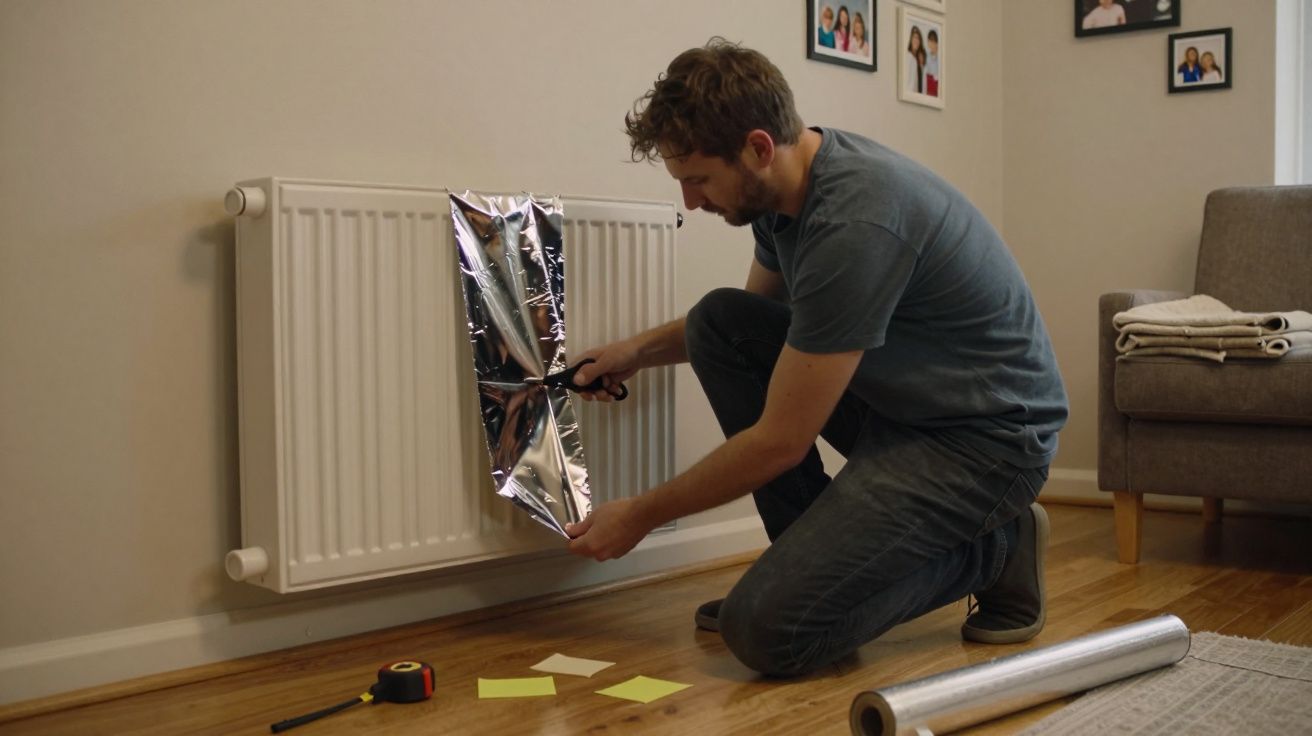
You don’t need to take radiators off the wall or call in a plumber to use reflector foil properly. You do need to be neat and a little methodical.
For a typical panel radiator on an external wall:
Gather what you need
- A roll of radiator reflector foil or heavy‑duty kitchen foil backed with card or thin foam board
- Scissors and a tape measure
- Double‑sided tape, sticky pads or small blobs of removable adhesive
- A ruler or long piece of cardboard to help slide panels down
- A roll of radiator reflector foil or heavy‑duty kitchen foil backed with card or thin foam board
Measure the “hot zone”
Measure the width and height of the radiator, then mark out panels slightly narrower than the gaps between the brackets or vertical columns. You want several vertical strips rather than one huge sheet, so air can still move freely.Stick foil to a backing
If you’re using kitchen foil, fix it to card or thin foam with the shiny side facing the room. Purpose‑made products already have a backing. This stiffness helps the foil sit flat and stops it tearing.Fix panels to the wall, not the radiator
Put small pads or strips of tape on the back of each panel. Slide them down behind the radiator from above, shiny face towards the room, and press gently against the wall. Leave a small air gap between foil and radiator where possible.Check clearances and valves
Make sure you haven’t covered the thermostatic radiator valve or any pipes, and that air can still flow up behind and over the top of the radiator. The foil should be invisible from normal standing height.
Common mistakes are predictable – and avoidable:
- Sticking foil directly onto the hot metal, where it can trap dirt and flake.
- Using one continuous sheet that seals the wall, encouraging condensation on cold masonry.
- Letting foil foul the valve or rub against pipework.
- Expecting a giant leap in temperature after one hour and declaring the whole idea “useless” when you don’t get it.
Done cleanly, it’s a reversible, low‑risk tweak: peel it off in spring if you hate it, or move it with you when you leave a rental.
Where this trick actually helps – and where it’s just shiny wallpaper
Reflector foil has very specific strengths. It’s not a universal cure.
It tends to be most effective:
- Behind radiators on external walls that feel cold to the touch
- In older solid‑wall properties without cavity insulation
- In small rooms where a single radiator does most of the work
- On north‑facing walls that rarely see direct sun
It does much less in these cases:
- Radiators on internal walls between two heated rooms
- Modern homes with well‑insulated cavities or insulated plasterboard
- Rooms where the radiator is oversized and already heats the space easily
- Behind designer radiators that already incorporate reflective panels
A quick rule of thumb many heating engineers use: if your wall feels almost as cold as the outside on a winter’s evening, foil has something to offer. If it feels only gently cool, your insulation is likely doing most of the work already.
You can think of it this way:
| Situation | Foil impact | Notes |
|---|---|---|
| Old brick external wall, single radiator | Noticeable comfort boost | Good candidate; combine with draught‑proofing |
| Modern insulated wall | Very modest change | Low‑cost, but don’t expect to feel much |
| Internal wall between rooms | Barely useful | Foil mainly decorative in this case |
Making foil part of a wider “warmer room” routine
A strip of foil behind the radiator is not a substitute for decent insulation, double glazing or a boiler that actually works. It’s one small lever among several.
To get the most from that £5 roll, pair it with simple, low‑effort habits:
- Bleed your radiators once or twice a season so hot water reaches the top.
- Keep furniture 10–15 cm away from the front of radiators so air can circulate.
- Avoid long curtains or sofas completely blocking the heat source.
- Shut doors to keep warmth in the rooms you’re actually using.
- Close curtains at dusk, but tuck them behind the radiator rather than over it.
Seen together, these changes shift a room from “just about tolerable” to “comfortably warm at a slightly lower thermostat setting”. The foil is simply the hidden part of that routine, doing its quiet work out of sight.
| Key point | Detail | Why it matters |
|---|---|---|
| Target cold external walls | Foil reduces radiant heat lost into masonry | Room reaches the same temperature with less effort |
| Fit panels, not a full sheet | Keeps airflow and reduces condensation risk | Radiator and wall can still “breathe” |
| Combine with basic maintenance | Bleeding and unblocking radiators boosts overall output | Small tweaks stack into real comfort gains |
FAQ:
- Can I just use ordinary kitchen foil behind my radiator?
You can, but it works best when fixed to a stiff backing such as card or thin foam, with the shiny side facing the room. Purpose‑made radiator foil is tougher, easier to handle and designed to cope with repeated heating and cooling.- Is it safe to put foil behind hot radiators?
Yes, when installed correctly on the wall with a small air gap, reflector foil is safe with standard hot‑water radiators. Avoid covering valves, cables or sockets, and do not use loose foil around electric heaters or open elements.- Will this noticeably cut my heating bills?
Expect a gentle reduction, not a dramatic one. In a poorly insulated room, foil can help the radiator warm the space more efficiently, which may let you run the system at a slightly lower setting or for shorter periods.- Could it cause damp or mould on the wall?
Continuous, sealed sheets can trap moisture, especially on cold external walls. Using smaller panels with gaps between them lets air move and reduces this risk. If your wall already has damp issues, tackle those first.- Should I bother in a new‑build home?
In many modern properties with good insulation, the gain from reflector foil is marginal. It’s still a cheap experiment, but your money and effort may be better spent on draught‑proofing, smart controls or simple habits like zoning which rooms you heat.





Comments (0)
No comments yet. Be the first to comment!
Leave a Comment