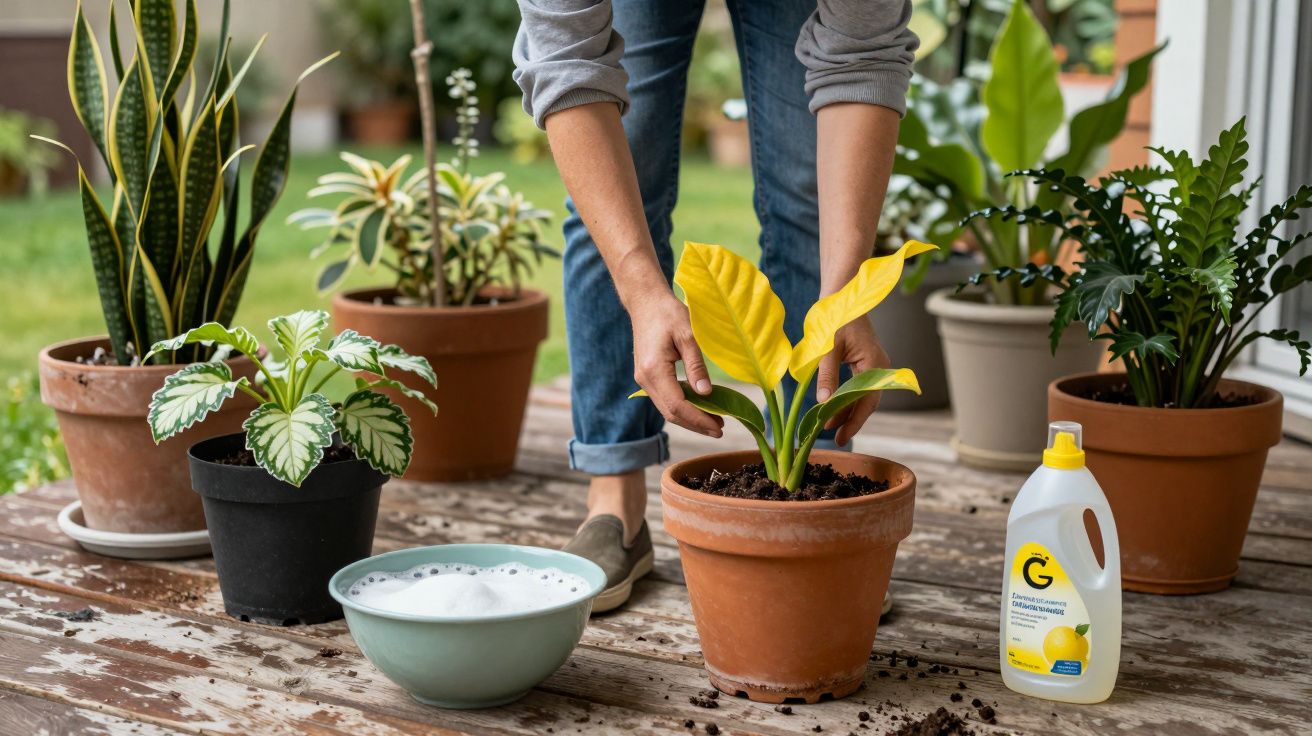
The first time I tipped the washing‑up bowl over my patio pots, it felt quietly brilliant. Warm, lemon‑scented water, straight onto thirsty compost instead of down the plughole. Somewhere in the back of my mind I imagined a smug little eco halo pulsing above the rosemary.
For a few weeks, nothing dramatic happened. The geraniums flowered on, the mint did its usual mint thing and tried to escape the pot. Every now and then, if the sink was full of suds and the forecast looked dry, I’d carry the bowl out and pour it around the base of whatever looked droopy. Waste not, want not.
Then the leaves started to look… off. Not a big, cinematic wilt. Just a tiredness around the edges. A bit more yellow here, a crisp brown tip there. The soil stayed oddly damp on top but dried hard as biscuit underneath. When I finally knocked one plant out of its pot to have a look, the compost fell away in lumps and the roots looked patchy and stunted, like they’d given up halfway.
It was a soil scientist friend who said, with the gentle patience of someone used to bad news, “You haven’t been using washing‑up water on these, have you?”
I had. A little, often. Exactly the pattern that creeps up on plants.
The problem isn’t one rogue bowl of suds. It’s the quiet build‑up in the soil, week after week, that roots can’t walk away from.
Why washing‑up water and roots don’t really get along
On the face of it, washing‑up water looks harmless. It’s mostly water, a bit of soap, a few crumbs. Compared to bleach or oven cleaner, it feels positively wholesome. The trouble is, plants and soil life live by different rules to your plates.
Most modern washing‑up liquids contain four things that spell slow trouble outdoors:
- Surfactants – the actual “washing” bit that cuts grease.
- Salts – used to thicken the liquid and boost cleaning.
- Fragrances, dyes and preservatives – the nice smell and the long shelf life.
- Antibacterial agents – in some “hygiene” or “antibac” formulas.
In the sink, surfactants are heroes: they break the bond between fat and plate so you can rinse everything clean. In soil, that same talent becomes a vice. Surfactants:
- Strip the waxy coating from fine root hairs, making them more vulnerable.
- Disrupt the delicate water film that clings to soil particles.
- Help dissolve organic glues that hold crumbs of soil together.
Roots like soil that’s crumbly and stable, with tiny pockets of air and water. Surfactants are brilliant at turning structure into sludge.
The salts and additives bring their own quiet side‑effects:
- Salts pull water towards themselves. In high enough doses, they make it harder for roots to draw up moisture, even when the compost looks wet.
- Artificial fragrances and dyes don’t usually kill a plant outright, but they add to the chemical load microbes have to process.
- Antibacterial agents don’t know the difference between germs on a chopping board and the beneficial bacteria that help roots take up nutrients.
From the plant’s point of view, you’re slowly turning its pot into a place where drinking gets harder just as the chemistry gets weirder.
The slow damage you don’t notice until leaves start complaining
If you poured a full bottle of undiluted washing‑up liquid onto a plant, you’d see the burn within days. Leaves would scorch, stems might collapse, and you’d never do it again. That’s not how most of us get into trouble.
We rinse a few plates, tip the bowl out once or twice a week, and feel faintly virtuous about “reusing greywater”. The soil doesn’t scream. It sighs.
Here’s what tends to happen over a season:
Surfactants and fats form a subtle “film”
Food grease plus detergent can clog the finest pores in compost. Water starts to run down the sides of the pot instead of soaking through evenly. The top can look damp while the root zone stays patchy and dry.Salts accumulate near the surface
Every time the water evaporates, a tiny residue stays behind. You might notice a pale crust on the compost or inside the rim of the pot. That’s your hint the roots are sitting in a slowly concentrating soup.Soil life thins out
The fungi and bacteria that recycle dead bits into new nutrients are sensitive. Repeated dousing with detergent, especially anything “antibacterial”, flattens the crowd. With fewer helpers, compost gets tired faster and roots find less to eat.Roots retreat, leaves sulk
Fine root hairs die back. New roots stick closer to the surface where oxygen is easier, but that’s also where salt levels are highest. Above ground, you get:- Browning tips on older leaves.
- A general dullness of colour.
- Wilting on hot days despite moist compost.
By the time you’re noticing these symptoms, the damage underneath is usually months in the making. One more bowl of lemon‑fresh water won’t look like the villain. The pattern will.
What soil experts warn about isn’t instant death. It’s the kind of chronic stress that quietly shortens a plant’s life.
What’s actually in that bowl? A quick peek
| What’s in the water | What it does in soil |
|---|---|
| Surfactants (the “soap” bit) | Break down soil structure, strip fine roots, change how water moves. |
| Salts and thickeners | Build up over time, making water harder for roots to take in. |
| Antibacterial additives | Knock back beneficial microbes as well as “bad” ones. |
| Food scraps & fat | Attract pests, go rancid, clog pores, steal oxygen from roots as they rot. |
Eco‑label detergents often have gentler formulas and fewer extras, but they’re still designed for plates, not petunias. “Plant‑based” on the bottle doesn’t mean “happy poured repeatedly into a 30cm terracotta pot”.
When you can reuse washing‑up water without wrecking the soil
All of this doesn’t mean you must never, ever reuse greywater in the garden. It means you need to be fussy about which water goes where, and how often.
Better candidates:
Very dilute, very occasional:
A nearly clear rinse bowl with a tiny smear of mild, non‑antibacterial liquid, used once in a dry spell, is far less of an issue than thick suds twice a week.On established, in‑ground plants:
Trees, hedges and big shrubs in the ground are more buffered than herbs in a pot. Their root systems spread far beyond one splash of detergent.Onto soil, not leaves:
Always pour at the base, never over foliage. Leaves are even less forgiving of detergents than roots.Rotated areas, not the same spot:
Move around. Don’t make the lavender by the back door the designated greywater martyr.
Situations to avoid altogether:
- Patio pots, hanging baskets and window boxes – tiny soil volume, nowhere for residues to go.
- Seedlings and young plants – fine, tender roots are the first to lose the fight.
- Anything labelled “antibacterial”, “disinfectant”, “bleach” or “hygiene boost” – these belong nowhere near soil.
- After greasy, meaty, or heavily salted meals – the fat and salt load is far more damaging than you think.
Let’s be honest: nobody keeps a lab log of what went down the plughole on Tuesday. If you can’t remember exactly how soapy or salty the bowl was, treat it as “too much” for your pots and send it down the sink.
A tiny habit that makes greywater safer
If the idea of “wasting” water still makes you twitch, there’s a middle ground that soil scientists tend to nod at rather than flinch from.
The trick is to separate plate‑rinsing water from actual washing‑up water.
Keep a clean washing‑up bowl or jug just for pre‑rinse water.
Rinse vegetables or quickly swill plates with plain water before you reach for the liquid. That first, almost‑clean water is fine for most outdoor pots.Only collect cool or lukewarm water.
Hot water can shock roots and soil organisms. If it’s too hot for your hand, it’s too hot for the pot.Dilute if in doubt.
Half a bowl of lightly soapy water topped up with fresh water in a watering can is kinder than pouring it neat.Feed the soil, not just wet it.
If you’re reusing greywater now and then, balance it with regular top‑ups of compost or leaf mould so there’s fresh organic matter for microbes to cling to.
One soil scientist I spoke to put it simply: “If you wouldn’t be happy drinking it after boiling, your pots won’t thank you for bathing in it every week.”
If you’ve already been doing it, what now?
If you’ve been faithfully tipping washing‑up water onto patio pots for months or years, this may all land with a slightly sick feeling. The good news is that pots are fixable. They’re small, contained worlds. You can hit reset.
Start with three steps:
Flush, don’t feed
For a few weeks, water pots deeply with plain tap or rainwater, letting excess run freely out of the drainage holes. The aim is to wash out built‑up salts. Don’t add fertiliser at the same time; stressed roots can’t handle a nutrient blast and a detox together.Look for crusts and smells
Scrape off any white or yellowish crust from the soil surface and bin it. If the compost smells sour or rancid, that’s a sign fat and food particles have been rotting. Those pots deserve a full repot.Repot the worst cases
Knock the plant out, gently tease off old compost, trim any dead or slimy roots, and replant into fresh, peat‑free compost. Water generously with clean water and keep in light shade for a week while it rebuilds.
Going forward, decide on a simple line:
“Patio pots get clean water only.”
Then keep your greywater experiments for tougher in‑ground shrubs, and even then, sparingly.
The quiet win of keeping it simple
Standing at the sink, it’s easy to feel squeezed between drought warnings and grim‑faced bottles telling you 99.9% of bacteria must die. The instinct to make every drop do double duty is understandable.
Yet when you talk to people who spend their lives looking at roots under microscopes, a different picture emerges. They’ll tell you that pots are harsh environments already: limited space, fast‑changing moisture, baking sun on a July afternoon. Add regular doses of detergent and salt, and you turn a tough gig into a near‑impossible one.
Clean water in, healthy roots out, better flowers, more herbs for your dinner. It sounds almost childishly simple next to the cleverness of “reusing greywater”. But simplicity is often what plants recognise as kindness.
You don’t need a spreadsheet of surfactants or a degree in soil chemistry. You just need a rule your tired Sunday‑evening brain will actually remember: plates get soap, pots don’t.
FAQ:
- Is it ever safe to use washing‑up water on patio pots?
Very occasionally, if it’s only very lightly soapy, well diluted, fully cooled, and you move around different pots rather than hitting the same ones repeatedly. As a routine watering method, soil experts strongly advise against it.- Are “eco” or “plant‑based” washing‑up liquids OK for plants?
They’re usually less harsh and contain fewer additives, but they’re still designed to break down grease, not nurture roots. Treat them as “slightly less bad”, not “plant food”.- Can I use washing‑up water on the lawn instead?
A healthy, established lawn can shrug off the occasional bowl of mild, diluted, non‑antibacterial washing‑up water far better than pots can. It still shouldn’t be a daily habit.- How do I know if my pot has detergent or salt build‑up?
Look for a pale crust on the compost surface or pot rim, leaves with brown, crispy tips, and compost that seems to stay oddly wet yet plants still wilt in heat. These are classic signs of salt stress.- What’s a better way to save water in the garden?
Collect rainwater in a butt, mulch pots to reduce evaporation, choose slightly larger containers that dry out more slowly, and water in the cool of the morning or evening so less is lost to the air. These changes are gentler on both plants and soil than regular doses of washing‑up water.



Comments (0)
No comments yet. Be the first to comment!
Leave a Comment