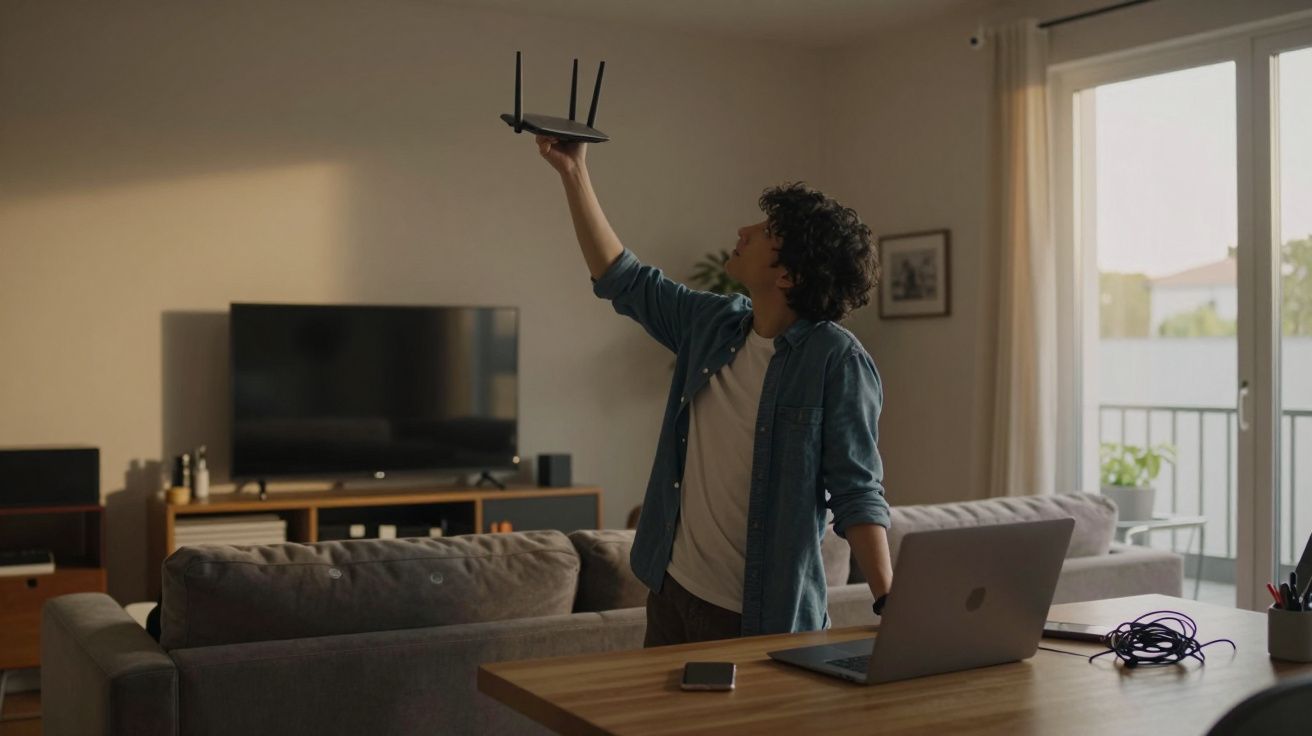
Your cursor blinks at a frozen inbox, the video call chokes, and the TV throws up that small spinning circle that feels like a personal insult. You glance at the clock. It’s 8.17pm. Again.
Up and down the street, kids are doing homework on tablets, someone’s firing up a game console, and three houses along, a neighbour has just pressed play on another box set. Your phone still claims “full bars”, but the connection feels like it’s wading through treacle. You start to wonder if your broadband is just bad, or if there’s some secret engineers know that you don’t.
The good news: you’re not imagining the pattern. Evening slowdowns are real. And there is one simple router move that broadband engineers quietly recommend, plus a handful of small tweaks that can turn those peak‑time tantrums into a calm, steady connection.
Why your Wi‑Fi slows at the same time every evening
Two things collide after about 7pm: busy networks and tired Wi‑Fi.
On the network side, this is peak time for streaming, gaming and video calls. Your provider’s lines, your street cabinet and even the servers you’re talking to are all under heavier load. That doesn’t always mean they’re overloaded, but any weak link in the chain becomes more obvious when everyone’s online together.
Inside your home, your Wi‑Fi has its own rush hour. Every device wakes up: smart TVs, laptops, phones, speakers, thermostats. Neighbours’ routers do the same. All of those signals share the same few channels of air. The result is digital traffic: not always a fault, but enough collisions and retries to make your broadband feel like it’s slowed to a crawl.
In most homes, the problem isn’t the broadband line. It’s where the Wi‑Fi has to fight from.
Which is where the engineer’s favourite advice comes in.
1. Make the engineer’s favourite move: liberate the router
Walk around any UK living room and you’ll see the same thing: a router slumped behind the telly, half-buried in dust and cables, or wedged on the floor by the master socket. It works, mostly, until the evening arrives and walls, furniture and electronics turn that tucked‑away spot into a signal maze.
Broadband engineers almost always ask you to do one thing first: move the router into the open. The internal antennas throw out a signal like a soft sphere. Hide that sphere in a corner or cabinet and half your Wi‑Fi vanishes into brick and MDF before it even reaches the room.
The placement they wish everyone used
Aim for these three rules:
- High: about shelf height, not on the carpet. A bookcase or sideboard is ideal.
- Central: as close to the middle of your home as the cabling allows, not in one far corner by the front door.
- Clear: nothing directly in front of it – no TV, fish tank, mirror, or stack of magazines.
If the master socket is in an awkward place, a short, good‑quality extension cable can bring the router out onto a nearby open surface. Keep that cable as short as is practical and avoid cheap, flimsy leads that can introduce their own problems.
You’ll know you’ve done it right when you can see the router from the room you use the most in the evening. It may not look as tidy, but it finally has room to do its job.
2. Tame the evening signal killers in your own home
Once the router’s free, look at what happens around it between 7pm and 10pm. Certain everyday objects become surprisingly disruptive at exactly the time you need a smooth connection.
Common culprits include:
- Microwaves – they leak noise on the same 2.4 GHz band as many Wi‑Fi networks.
- Cordless phones and baby monitors – older models in particular can stomp all over Wi‑Fi channels.
- Big blocks of metal or water – fridges, radiators, fish tanks and even hot water cylinders absorb or reflect signal.
- Mirrors and foil‑backed insulation – they don’t just bounce light.
You don’t have to redesign the entire room. Small moves help:
- Slide the router at least a metre away from the microwave wall or big metal appliances.
- Keep it off the floor so it’s not blasting straight into radiators or the back of the TV stand.
- If you have a choice of socket, resist the one right next to the boiler cupboard.
Think of your router as needing a little bubble of air and line of sight. If you’d trip over it in the dark, it’s probably in a good spot.
3. Give your hungriest devices a wired “fast lane”
Wi‑Fi is brilliant for phones and tablets. It’s less brilliant when a 4K TV, games console and laptop are all yelling for bandwidth at the same time over the air.
Broadband engineers quietly love an Ethernet cable because it removes arguments from the airwaves. If you can:
- Plug your TV, games console or work PC directly into the router with a network cable.
- If they’re in another room, use a decent powerline kit (those adapters that plug into wall sockets and carry data over your home’s wiring).
That instantly frees up Wi‑Fi for devices that can’t be wired, and it makes the heavy streamers more stable. Your evening Netflix session stops wrestling with your teenager’s online game and your own video call.
4. Change one setting your neighbours can’t see
Even after you move the router, your Wi‑Fi may still be elbow‑to‑elbow with next door’s network at peak times. Most routers pick a channel automatically, but they don’t always make the best choice once the street fills up.
Two small changes can help:
a) Use 5 GHz where you can
Most modern routers broadcast both 2.4 GHz and 5 GHz networks.
- 2.4 GHz goes further and through walls more easily, but it’s crowded and slower.
- 5 GHz is faster and less congested, but shorter range.
If your devices let you choose, connect anything within the same room or next room (TV, laptop, console) to the 5 GHz network. Leave 2.4 GHz for smart plugs and boxes at the edges of the house.
Some providers label them with “_5G” at the end of the network name. Others let you split or rename them in the router settings or app.
b) Nudge the channel
Your router has a web page or app where you can:
- See which channel your Wi‑Fi is using.
- Switch to a quieter one (your provider’s support pages usually show how).
In a dense block of flats, simply hopping to a less crowded channel on 2.4 GHz can shave off evening slowdowns, because your router spends less time repeating itself over other people’s chatter.
5. Check the broadband, not just the Wi‑Fi
Sometimes the problem isn’t the wireless at all; it’s the line feeding it.
To separate the two:
Run a wired speed test
Plug a laptop into the router with an Ethernet cable and test at a quiet time, then again at your worst evening hour. Use the same reputable speed test each time.Compare the results
- If wired speeds stay healthy but Wi‑Fi tests drop in the evening, it’s a wireless issue.
- If wired speeds also nosedive after 7pm, your provider’s network may be congested or your line may be underperforming.
Check what you’re paying for
Look at your contract’s “estimated” or “minimum” speeds. If your wired evening result is consistently below the minimum, you have a concrete case for support.
The win comes from knowing whether to move furniture or push your provider.
When to call your provider – and what to say
If you’ve:
- moved the router into the open,
- wired up the hungriest devices,
- tweaked Wi‑Fi bands or channels,
…and evening speeds are still poor even over a cable, it’s time to speak to your broadband company.
Have this information to hand:
- Your wired speed test results (times and speeds, ideally from a couple of evenings).
- Confirmation you’ve tested from the main socket or test socket if you have one.
- Any connection drops or flashing lights on the router when things slow.
Explain that speeds fall below the promised minimum in the evenings, even on a wired connection. That signals a problem they can’t fix with a script and often prompts checks on your line, cabinet or an upgrade to a different product if your usage has outgrown the current one.
The small nightly routine that keeps things smooth
Most people don’t want to become their own network engineer. You don’t have to. A simple pattern is enough:
- Give the router a good home once, then leave it there.
- Keep big streamers on cables where you can.
- Use 5 GHz for nearby devices and let 2.4 GHz handle the edges.
- When something feels off, test wired vs wireless before you panic.
Your Wi‑Fi may still slow a little when everyone’s online, but it doesn’t need to stall, stutter and time out. The difference between an infuriating evening and a calm one is often just a router brought out of hiding and treated like the tiny radio tower it really is.
FAQ:
- Will turning the router off every night help speeds? Not usually. A quick reboot can clear a glitch, but switching off daily can interrupt line monitoring and sometimes make your connection look unstable to the provider. Keep reboots for when things are clearly stuck.
- Is a new, expensive router always the answer? Only if your current one is very old or doesn’t support dual‑band Wi‑Fi. In many homes, simply moving the existing router and wiring key devices makes a bigger difference than buying shiny new kit.
- Does Wi‑Fi “boosting” with cheap plug‑in extenders work? It can, but extenders also halve the available bandwidth if they just repeat the same network. If you need to reach a far room, a mesh system or powerline adapters are usually more reliable than bargain extenders.





Comments (0)
No comments yet. Be the first to comment!
Leave a Comment